Treatment
I have Alzheimer's – that's why I measure my blood sugar
Article no. 33 · June 13, 2026 · Updated September 20, 2026 ·

When one receives an Alzheimer's diagnosis, the healthcare system's response is to give the patient a symptom-relieving medication. That's all. But diet and lifestyle can likely truly slow the disease's progression, yet the patient is left to explore what is reasonable and possible on their own. This article was revised on June 16th.
The state of knowledge is still uncertain. At the same time, there is much to suggest that exercise, sleep, social activity, cognitive stimulation, and diet can be significant for how one lives with the disease.
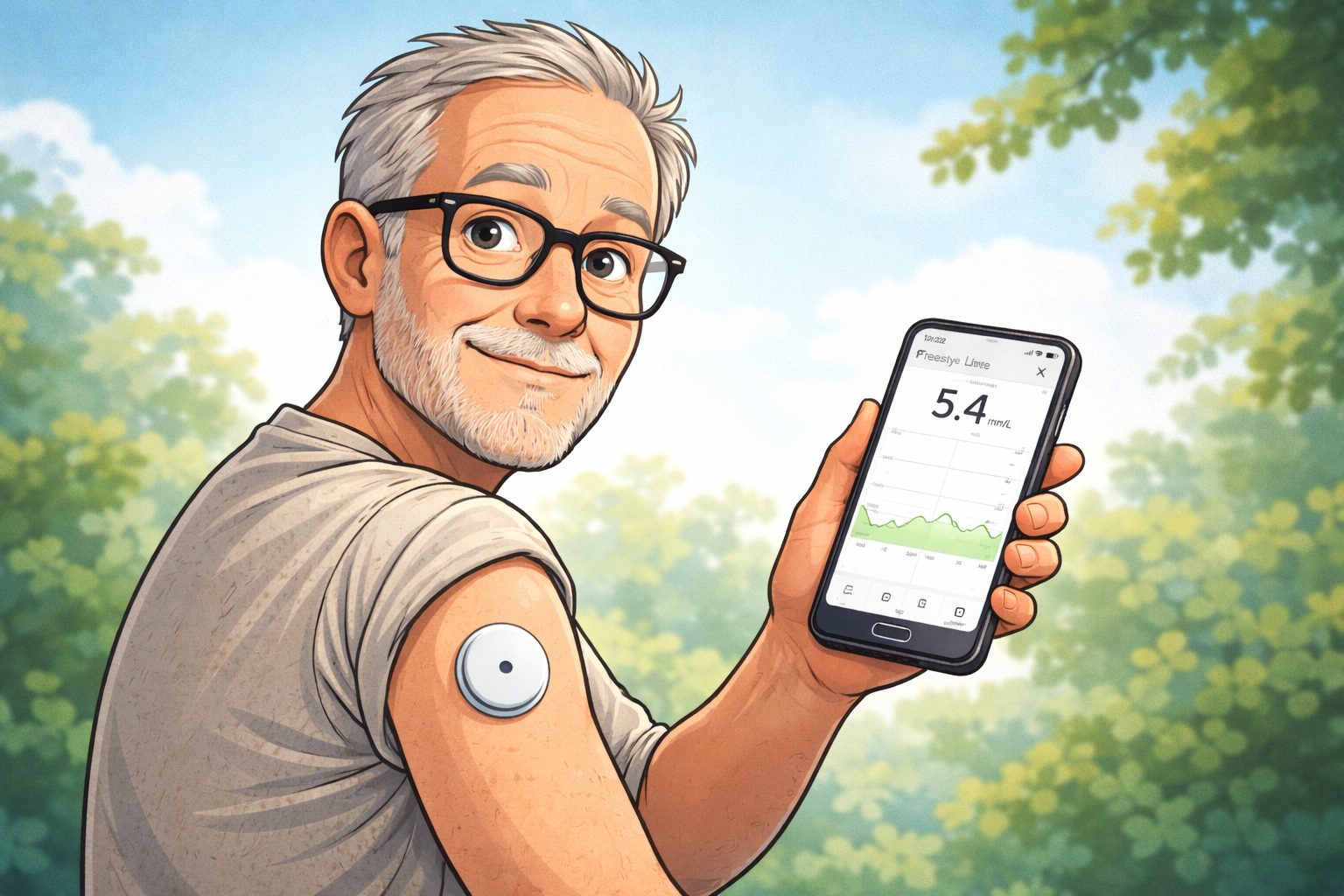
Researchers have long known that the brain in Alzheimer's gradually finds it harder to use glucose. This has made me interested in the brain's energy supply, and I occasionally use a continuous glucose monitor (CGM) on my arm, even though I don't have diabetes.
The brain starves – even though there is energy in the blood
In Alzheimer's, the brain gradually loses some of its ability to use glucose, meaning that energy is not metabolized as efficiently as before.
_The body can be well-nourished. Blood sugar can be normal. Yet, the brain can be in a state of energy deficit._
Avoiding blood sugar spikes
Strong glucose surges can, over time, contribute to insulin resistance. High levels can also increase inflammation, which is an important part of the disease process. In addition, there is oxidative stress that can damage nerve cells.
A stable energy supply can therefore be beneficial for a brain that already has difficulty utilizing energy.
That's why I use a blood sugar sensor
I use Abbott's FreeStyle Libre 3 – a CGM sensor that sits on my upper arm and sends glucose values to my mobile phone around the clock. The sensor is active for 14 days and costs 1,700 SEK. As it stands now, I use one perhaps once every other month. More is not needed for me to get enough data for my protocol on the outcome of different meals.