Opinion
The Dementia Debate Gets Stuck on the Wrong Questions
Article no. 22 · April 21, 2026 · Updated September 20, 2026 ·
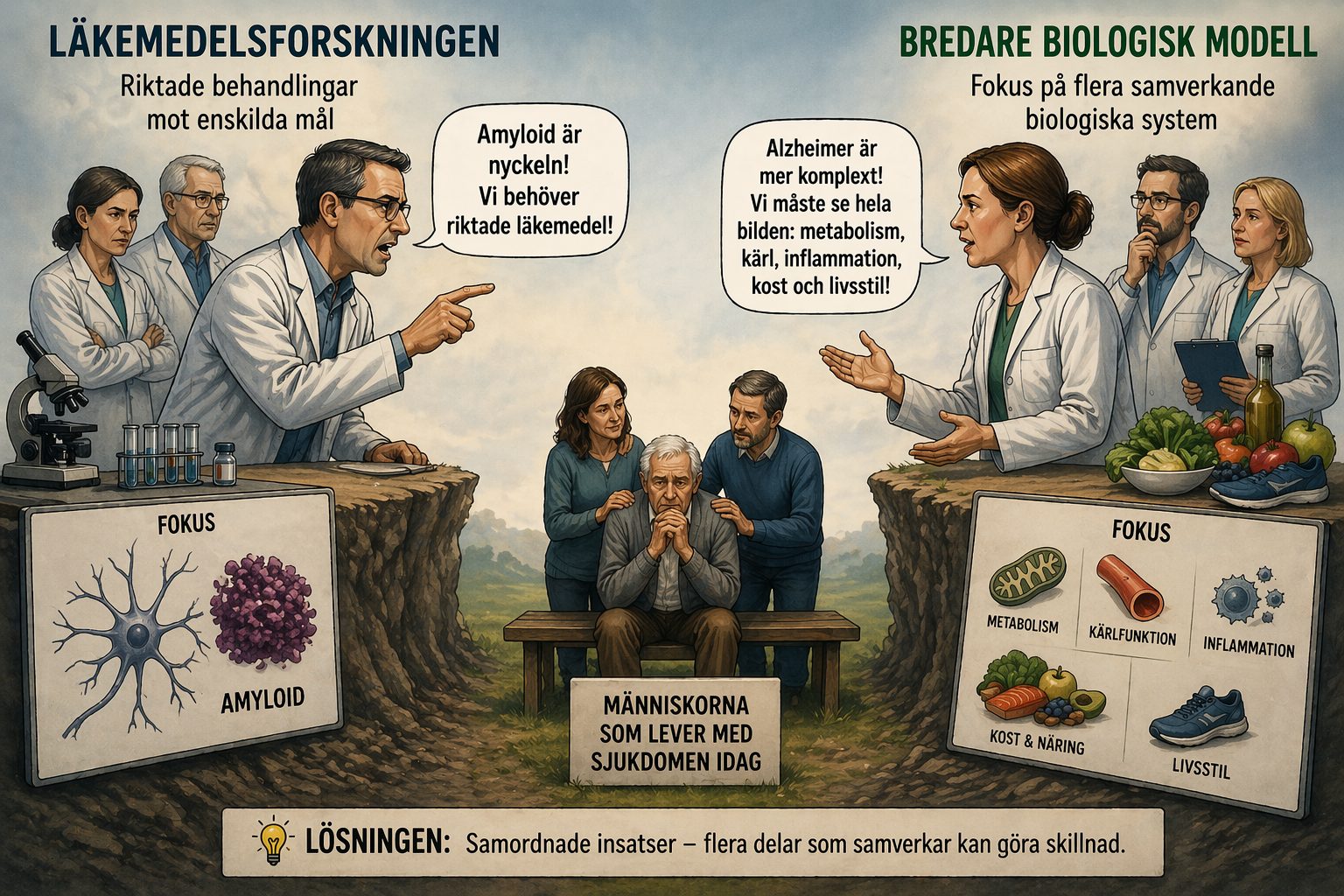
The Swedish dementia debate currently seems to follow two lines of conflict; one about research and one about policy. But the crucial question is not about scientific perspective, but about what can actually be done for us who live with the disease?
The first conflict concerns the focus of research. Here, two scientific traditions stand against each other.
Research
On one side, there is established pharmaceutical research that tries to develop targeted treatments against the processes driving the disease in the brain, such as amyloid. On the other side, there are researchers and doctors who believe that Alzheimer's is more complex and that treatment therefore must be broader – focusing on metabolism, vascular function, inflammation, diet, and lifestyle.
Policy
Policy aims to strengthen both scientific lines. Through universities, established pharmaceutical research has been promoted.
The new development is that the government explicitly wants to strengthen dementia care through earlier diagnoses, better investigations, and more support for relatives. Critics argue that this risks becoming quite empty as long as there are no drugs that truly slow down the disease.
Between Two Extremes
In practice, the discussion often ends up in a false choice between two extremes.
One extreme is the hope for the great medical breakthrough – a drug that on its own slows down the disease. The problem is that even the most talked-about new drugs so far have had only very limited effect.
The other extreme is a more resigned attitude: since there is no cure, there isn't much to do (this I recognize from my own health center).-